

Table of Contents
- Why Streetwear Gym Wear for Men Works Harder Than Standard Kit
- The Non-Negotiables: Fabric, Fit, and Sweat Management
- Streetwear Gym Outfits for Men: Four Formulas That Work
- Oversized Gym Clothes for Men: Style Without the Snags
- Building the Rotation on a Budget: Cost Per Wear Beats Sticker Price
- Care, Odor Control, and Making Streetwear Gym Wear Last
- Conclusion: Dress for the Grind, Not the Trend
- Frequently Asked Questions
Last Updated: October 4, 2026
Why Streetwear Gym Wear for Men Works Harder Than Standard Kit
Most men's gym clothing fails between two worlds: it performs in the gym but looks like pyjamas on the street, or it looks sharp but breaks down under heavy training. This guide from Tru Nobilis breaks down the fabrics, fits, and outfit formulas that hold up to daily lifting and still work outside the gym.
The shift is practical, not cosmetic.
Here's the core argument: streetwear style is easy to copy, but streetwear durability is not. Plenty of brands nail the look. Far fewer build apparel that survives heavy squats five days a week without pilling, stretching, or losing shape.
Below: the non-negotiables, four outfit formulas, and how to build a rotation that outlasts the trend cycle.
The Non-Negotiables: Fabric, Fit, and Sweat Management
Three things decide whether gym wear works or wastes your money: what the fabric does with sweat, how the cut moves with you, and whether it survives repeated washing.
Most guides stop at "look for moisture-wicking fabric." That advice is useless alone, because the right fabric depends on what you are doing in it.
Moisture-wicking means the fabric pulls sweat away from your skin to the surface, where it evaporates faster.
Match Fabric Weight and Stretch to Your Workout Type
Use this as a decision guide: pick fabric weight, stretch, and sweat management based on the session you are walking into.
Strength training and heavy lifting. You want mid-weight knits with moderate four-way stretch and a slightly denser hand-feel.
Low-impact sessions, mobility work, and recovery days. Here you can lean into streetwear aesthetics without a performance penalty.
Cross-training and mixed sessions. The hardest category to buy for, because you are asking one garment to do two jobs.
Moisture-Wicking Workout Shirts: What Actually Matters
Look for breathable, lightweight knits with a bit of stretch. A good workout shirt manages sweat without feeling like plastic against your skin, and ventilation matters most across the back and underarms, where heat builds fastest.
What most guides miss: fit matters as much as fabric. Too tight restricts your range of motion on overhead presses; too loose bunches under a bar. A tailored fit through the torso with room at the shoulders is the sweet spot.
Men's Training Shorts: Length, Liner, and Lift-Friendly Cuts
Men's training shorts come down to three decisions: length, liner, and cut.
- Length: 5-inch inseams suit lifting and running; 7-inch suits general training and gym-to-street wear.
- Liner: A built-in liner removes the need for separate underwear and reduces chafing.
- Cut: A gusseted crotch and side splits let you hit depth on squats without the fabric fighting you.
Athletic shorts built for strength training use flexible, durable fabric that stretches in four directions, keeping them from splitting at the seam when you go heavy. For running and conditioning, prioritize a lighter woven or knit with more ventilation and a shorter inseam so the hem clears your stride. For gym-to-street, a 7-inch inseam in matte, structured fabric reads more streetwear than track short.
Streetwear Gym Outfits for Men: Four Formulas That Work
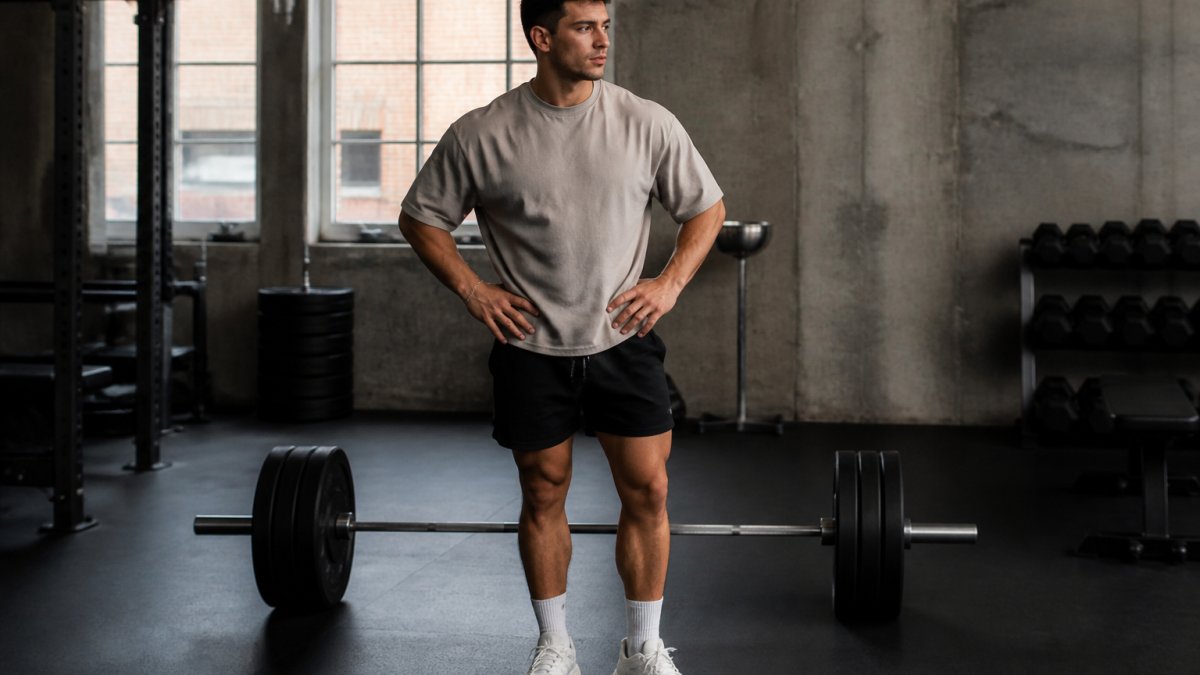
The fastest way to build streetwear gym outfits for men is to start from a formula and adjust. Each pairs a top, a bottom, and footwear for a specific job.
| Formula | Top | Bottom | Best For |
|---|---|---|---|
| Heavy Lift Day | Oversized moisture-wicking tee | 5-inch lined training shorts | Squats, deadlifts, presses |
| Conditioning and Cardio | Lightweight tank or sleeveless top | 5-inch athletic shorts | Running, circuits, HIIT |
| Gym-to-Street | Long-sleeve shirt or clean tee | Joggers or training pants | Training then errands |
| Recovery and Hangout | Relaxed tee | Joggers or leggings | Light days, casual wear |
Formula 1: Heavy Lift Day
Pair an oversized moisture-wicking tee with 5-inch lined training shorts. The loose top gives shoulder room for pressing; the shorter short keeps the bar path clear on deadlifts. This is where durability matters most, because heavy loads stress every seam.
Formula 2: Conditioning and Cardio
Go lighter up top with a tank top or sleeveless top, paired with 5-inch athletic shorts. Maximum ventilation and movement for running gear and circuit work, breathable fabric beats style every time.
Formula 3: Gym-to-Street
This formula justifies the whole approach. Wear a long-sleeve shirt or clean tee with joggers or training pants, train in it, then walk out without changing. Gym-to-street only works when the fabric looks sharp after a session, not rumpled and soaked.
Oversized Gym Clothes for Men: Style Without the Snags
Oversized gym clothes for men are the signature of the active streetwear look, but the wrong oversized cut causes real problems under a bar.
The fix is deliberate sizing. Go one size up from your tailored fit, not two. Look for a dropped shoulder seam and a boxy body that still ends around mid-hip, the relaxed streetwear silhouette without the snags.
How to Size Oversized Tops Without Losing Function
Sizing oversized pieces is where the look either works or falls apart. A few rules:
- Start from your true size, then move one step. If you normally wear a medium in a fitted tee, buy a large in an oversized cut. Jumping two sizes is where you get fabric that swallows your hands and drapes over your face on a bench press.
- Check the shoulder seam placement. On a true oversized cut, the seam sits past the natural shoulder, roughly one to two finger-widths down the upper arm. If the seam is sitting at your elbow, the shirt is too big.
- Check the hem. The bottom of the shirt should land somewhere between your hip bone and the top of your thigh. Anything lower starts to interfere with a belt, a lifting belt, or the bar path on a deadlift.
- Check the sleeve. A relaxed sleeve should end just above the elbow, not past it. Sleeves that hang past the elbow catch on dumbbells during curls and on the bar during front squats.
Layering Oversized Pieces Without Overheating
Layering is where streetwear styling and gym function most often collide. The principle: keep the layer closest to your skin fitted and performance-focused, and let the outer layer carry the silhouette.
A tailored fit base layer under an oversized top traps a thin layer of air and keeps you warm without bulk.
A common pattern: a fitted moisture-wicking tee or tank as the base, then an oversized short-sleeve or long-sleeve performance top over it.
Coordinating Proportions So the Outfit Reads Intentional
Relaxed fit tops pair best with tapered bottoms. If the top is boxy, keep the shorts or joggers closer to the leg so the outfit reads intentional rather than shapeless. Casual wear and hangout wear both live comfortably in this zone.
The reverse also works: a fitted top with relaxed joggers gives a cleaner, more athletic line. What does not work is oversized on top and oversized on the bottom, that reads as borrowed clothing rather than styled streetwear.
A few proportion rules worth remembering:
- One oversized element per outfit. Let the top be the statement, or let the bottom be the statement, not both.
- Match hem lengths to footwear. A cropped jogger cuff over a chunky sneaker reads streetwear; a long, pooling hem over the same sneaker reads sloppy.
- Keep the color palette tight. Two or three tones maximum. Streetwear styling leans on silhouette and proportion, not on loud prints.
Building the Rotation on a Budget: Cost Per Wear Beats Sticker Price
Cheap gym wear is the most expensive option over time.
Think in cost per wear. Divide what you pay by the number of times you realistically wear the item. A garment you train in four times a week for two years delivers hundreds of wears.
A lean, disciplined rotation beats a crowded, trend-driven closet:
- 3-4 moisture-wicking tops you actually trust
- 2-3 pairs of training shorts
- 1-2 pairs of joggers or training pants for gym-to-street
- 1 long-sleeve layer for cooler sessions
This is where Tru Nobilis fits. Our streetwear-inspired training apparel is built for durability and made to outlast the grind, so a smaller rotation goes further.
Buying five cheap tops instead of two durable ones feels like saving money. It is not. You will replace the cheap ones twice a year and still end up buying the durable option anyway.
Care, Odor Control, and Making Streetwear Gym Wear Last
Odor control starts with sweat management, not detergent. Fabric that wicks and dries fast gives bacteria less time to build up. Fabric that stays damp holds smell, which is why cotton gym wear develops a permanent funk.
A few habits extend the life of every garment:
- Wash training apparel after each wear, in cold water
- Skip fabric softener; it coats performance fibres and blocks wicking
- Air-dry when you can; heat breaks down elastane and stretch
- Turn printed pieces inside out before washing to protect the design
Conclusion: Dress for the Grind, Not the Trend
The hard part of streetwear gym wear is not finding the look. It is finding apparel that keeps the look after months of heavy training. Trends fade; a rotation built on durable fabric and honest construction keeps working.
At Tru Nobilis, we build streetwear-inspired training apparel for the disciplined few who treat the gym like a mission.
Shop Now and build a rotation that holds up to the grind.
Frequently Asked Questions
How do you style streetwear for the gym without looking like you just came from a photoshoot?
Build the outfit around function first. Start with moisture-wicking workout shirts and men's training shorts that fit the movement you're doing, then add one streetwear element: an oversized tee, a heavyweight hoodie, or joggers. Keep colors to two or three, and let the cut carry the look. The goal is gear that performs under a barbell and still reads clean on the street, not a costume.
Can you actually wear streetwear clothes for heavy lifting and high-intensity training?
Yes, if the fabric and fit are right. Look for technical fabrics with stretch, sweat-wicking finishes, and flat seams that won't rub under a belt or straps. Avoid stiff cotton on heavy squat and deadlift days because it holds sweat and restricts range of motion. Streetwear-inspired training apparel built with four-way stretch handles both the lift and the walk home.
What should men look for in streetwear gym wear to make it last longer than a few months?
Check three things: fabric weight, seam construction, and wash instructions. Heavier knits with reinforced stitching hold shape through repeated washing, while thin blends pill and stretch out fast. Wash cold, skip fabric softener, and air dry when you can. Rotating four to five pieces instead of wearing the same two also spreads the wear and keeps odor from setting in.
Is streetwear gym wear for men only for the hardcore crowd, or can beginners wear it too?
It works at any experience level. A beginner can start with one pair of men's training shorts, one moisture-wicking workout shirt, and a pair of joggers, then add oversized gym clothes for men once the training habit sticks. The fit and fabric matter more than how advanced you are. Pick pieces that let you move through a full squat and press without adjusting.