

Table of Contents
- Why Workout Clothes Quality Matters for Your Training
- How to Test Sportswear Fabric Quality
- Best Fabric for Breathable Workout Clothes
- How Workout Clothes Should Fit
- Workout Clothes That Do Not Pill
- Durability and Longevity Indicators
- Quality Versus Price: Cost Per Wear
- Frequently Asked Questions
Last Updated: October 11, 2026
Why Workout Clothes Quality Matters for Your Training
Learning how to tell if workout clothes are high quality goes beyond brand names and price tags. At Tru Nobilis, we've designed our training apparel to withstand the punishment of serious athletes.

The difference between high-quality activewear and low-quality alternatives comes down to three things: the fabric itself, how it's constructed, and how well it performs under stress.
This guide walks you through exactly what to look for when evaluating workout clothes. You'll learn how to test fabric quality at home, spot construction flaws, and understand what makes certain materials better for intense training.
How to Test Sportswear Fabric Quality
Testing fabric quality doesn't require special equipment. You can evaluate most performance characteristics by hand and through simple checks you can do right in the store or at home.
Check the Fiber Blend and Material Composition
The fiber blend is where quality starts. Look at the care tag and read the material composition carefully.
Polyester is a workhorse fabric for athletic wear. It dries fast and resists shrinking. Spandex (also called elastane) provides stretch and recovery.
Natural fibers like cotton and wool have their place, but pure cotton absorbs sweat instead of wicking it away. Merino wool is an exception, it naturally regulates temperature and resists odor.
Check what you're actually getting:
- Read the full fiber content on the tag
- Avoid pieces with unclear or missing fiber information
- Look for blends specifically designed for athletic performance
- Synthetic-dominant blends typically outlast natural-fiber-heavy pieces
Perform the Stretch and Recovery Test
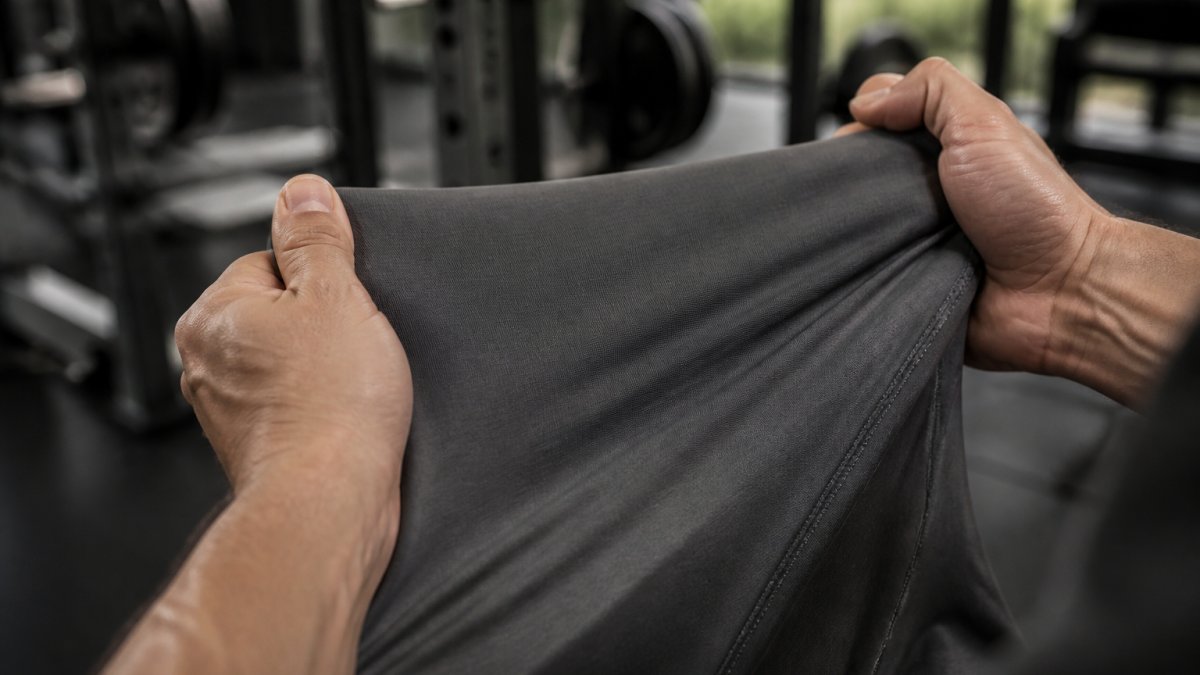
This is the single most important test you can do. Grab the fabric and stretch it firmly in different directions. Then release it immediately and watch what happens.
Quality fabric snaps back to its original shape within a second or two. Poor-quality fabric stays stretched out. This test reveals whether the spandex will hold up over time or whether it'll lose elasticity after a few washes.
Pull the fabric in multiple directions:
- Lengthwise (along the grain)
- Crosswise (across the grain)
- Diagonally
High-quality athletic wear has four-way stretch, meaning it recovers well in all directions. After you release, the fabric should return to its original size without wrinkles or sagging.
Assess Moisture-Wicking and Sweat Management
Pour a small amount of water onto the fabric and watch how it behaves. Quality moisture-wicking fabric repels water initially and then absorbs it into the fibers, pulling sweat away from your skin.
Water should bead up on the surface for a moment, then soak in. If water sits on top and doesn't absorb, the fabric won't manage sweat effectively during intense training.
Feel the fabric when it's damp. Quality pieces dry quickly and don't feel heavy or clingy. Budget fabrics stay wet and cold against your skin.
Best Fabric for Breathable Workout Clothes
Breathability matters when you're working hard. Your body needs air to circulate through the fabric so sweat can evaporate instead of pooling on your skin.
Synthetic Fibers for Performance
Polyester is the gold standard for breathable, performance-driven workout clothes. It's lightweight, dries fast, and doesn't retain moisture. High-quality polyester blended with spandex creates fabric that breathes while providing the stretch you need for dynamic movements.
Nylon is another synthetic option. It's durable and slightly lighter than polyester. Some premium brands use nylon for specific pieces where maximum breathability is the goal.
The advantage of synthetics is consistency. They perform reliably across dozens of washes and don't degrade the way natural fibers sometimes do.
Natural and Blended Options
Merino wool is exceptional for temperature regulation. It breathes well, resists odor naturally, and feels soft against skin. It's typically more expensive, but it performs across a wide temperature range.
Bamboo-derived fabrics like lyocell offer breathability and a soft feel. They're made from renewable resources and often have a luxury feel. However, they're less durable than polyester for heavy-duty training.
Blended fabrics that combine 60-70% synthetic fibers with 30-40% natural fibers can offer the best of both worlds: the durability and moisture-wicking of synthetics plus the comfort of natural materials.
How Workout Clothes Should Fit
Fit determines whether your gear actually supports your training or restricts your movement.
Range of Motion and Freedom of Movement
Your workout clothes should move with you, not against you. When you're doing heavy squats or deadlifts, the fabric should stretch without pulling or limiting your range of motion.
Test the fit by doing the movements you actually do in the gym:
- Squat down fully and check for tightness
- Raise your arms overhead and move them in circles
- Do a few lunges and see if the fabric bunches or restricts
- Perform any sport-specific movements you regularly do
Quality pieces have enough stretch and fabric give to accommodate your full range of motion. Seams shouldn't pull or dig into your skin during movement.
Opacity and Coverage During Intense Exercise
This is where many cheaper pieces fail. When you're doing high-intensity movements, your clothes shouldn't become see-through or ride up.
The fabric should maintain its opacity even when wet with sweat. Test this by stretching the fabric over a light source. You shouldn't be able to see through it easily, and when it's damp, it should stay opaque.
Check coverage during movement:
- Bend forward and make sure your back isn't exposed
- Do a full squat and verify the fabric doesn't ride up
- Jump or do dynamic movements and confirm the piece stays in place
High-quality athletic wear is designed with these movements in mind. Seams are placed strategically to prevent gaps.
Workout Clothes That Do Not Pill
Pilling happens when fabric fibers break and ball up on the surface. It makes clothes look cheap and worn out. Quality pieces resist pilling through better fabric and construction.
Fabric Strength and Abrasion Resistance
The stronger the fibers, the less likely they'll break and pill. High-quality polyester has thicker, more resilient fibers that withstand friction without degrading.
Feel the fabric carefully. Quality pieces have a smooth, consistent surface. If the fabric feels fuzzy or has a weak, delicate texture, it will pill easily.
Fabrics with higher thread count and tighter weaves resist pilling better. The fibers are locked together more securely, so they don't break free as easily.
Seam Construction and Finishing Quality
Look closely at the seams. Quality pieces have flat seams or reinforced seams that distribute stress evenly. Flat seams are sewn so the edges lie flat against your skin, reducing friction and pilling at seam lines.
Bias binding is another quality indicator. This is a strip of fabric sewn along edges to finish them neatly. It prevents fraying and reduces the friction that causes pilling.
Check the seams for these signs of quality:
- Straight, even stitching with no loose threads
- Flat seams that don't create ridges
- Finished edges with bias binding or similar reinforcement
- Double-stitched seams in high-stress areas like armholes
Poor-quality pieces have visible loose threads, uneven stitching, and raw edges that start fraying immediately.
Durability and Longevity Indicators
How long your workout clothes last depends on materials, construction, and how you care for them.
Garment Construction Details
Examine how the piece is put together. Quality pieces use reinforced construction in high-stress areas. Armholes, necklines, and seams where fabric experiences the most tension should be double-stitched or reinforced with extra fabric.
Look for these construction quality markers:
- Double-stitched seams in high-stress areas
- Reinforced necklines and armholes
- Properly finished hems with no loose threads
- Even, consistent stitching throughout
The way panels are cut and sewn together matters too. Premium pieces use pattern layouts that minimize waste and create stronger garments. Budget pieces often use inefficient cutting that creates weak points.
Care Instructions and Expected Lifespan
Read the care instructions. Quality pieces provide detailed washing guidance because the manufacturer stands behind their durability. If the tag just says "wash cold" with no other information, that's a red flag.
High-quality athletic wear typically lasts 1-2 years with regular training and proper care. Some premium pieces last longer. Budget pieces often start showing wear within 6 months.
The care label tells you what the manufacturer expects:
- Specific water temperature recommendations
- Instructions on drying (hang dry vs. machine dry)
- Warnings about fabric-specific care needs
- Any special treatments required to maintain performance
Quality pieces often require more careful washing because the fabrics are engineered for performance. This isn't a drawback, it's a sign the manufacturer designed the fabric to last.
| Quality Indicator | High-Quality Piece | Budget Piece |
|---|---|---|
| Fiber blend | 80%+ synthetic, clear composition | Mixed or unclear fibers |
| Stretch recovery | Snaps back immediately | Stays stretched out |
| Seam quality | Flat, reinforced, even stitching | Loose threads, uneven stitching |
| Opacity when wet | Stays opaque | Becomes see-through |
| Pilling resistance | Smooth surface after washing | Pills within weeks |
| Care instructions | Detailed, specific guidance | Generic or minimal info |
Quality Versus Price: Cost Per Wear
Price matters, but cost per wear matters more. A piece that costs twice as much but lasts twice as long is actually the better value.
Calculate cost per wear by dividing the price by the number of times you'll wear it before it wears out.
High-quality workout clothes from brands like Tru Nobilis cost more upfront, but they deliver better value over time.
Consider what you're actually paying for with premium pieces:
- Engineered fabrics designed for performance
- Reinforced construction that survives intense training
- Better moisture-wicking and temperature regulation
- Longer lifespan means fewer replacements
The Tru Nobilis Sports Bra exemplifies this value. Made from 82% polyester and 18% spandex with four-way stretch, it features flat seams and bias binding that eliminate rubbing.
High-quality workout clothes require you to look beyond the brand name and price tag. Tru Nobilis apparel is engineered for athletes who demand durability and performance. Shop our collection and experience the difference quality construction makes when you're grinding hard.
Frequently Asked Questions
How can you tell if workout clothes are good quality?
High-quality workout clothes show consistent stitching with flat seams and bias binding that eliminate rubbing. The fabric should have a dense weave with no loose threads, and when you stretch it, it should recover immediately without sagging. Check the fiber blend on the label, premium activewear uses performance synthetics like polyester and spandex in balanced ratios, or high-end natural fibers like merino wool. The garment should feel smooth without pilling, and construction details like double-layer fronts or reinforced shoulder straps indicate durability for intense training.
What is the best fabric for breathable workout clothes?
Polyester and nylon blends with spandex are industry standards for breathability and moisture-wicking. A 82% polyester, 18% spandex composition, like in the Tru Nobilis Sports Bra, provides excellent sweat management and four-way stretch recovery. Natural options include merino wool for temperature regulation and organic cotton for softness, though they dry slower than synthetics. The key is fiber composition that supports ventilation and quick-drying, look for fabrics specifically labeled as moisture-wicking and sweat-wicking to ensure sweat moves away from your skin rather than pooling.
How do I know if workout clothes will last through heavy training?
Durability depends on three factors: fabric strength, seam quality, and care. Examine the stitching, tight, even seams with reinforced stress points (shoulders, underarms, crotch) indicate longevity. Check the fabric weight and fiber blend; heavier, tightly woven synthetics resist pilling and abrasion better than lightweight blends. Read care instructions carefully; garments requiring gentle washing and air-drying typically last longer than those tolerating high heat. Quality activewear designed for intense training like weightlifting and high-intensity workouts should show no loose threads, fraying, or weak areas when inspected before purchase.
What should I look for when checking how workout clothes fit?
Proper fit allows full freedom of movement without excess fabric. In the shoulders and arms, you should raise your arms overhead and perform a full squat without restriction or seams pulling. The garment should hug your body without bunching at the waist or armpits. For bottoms, check that the fabric stays opaque during deep squats and deadlifts, squat-proof opacity matters for confidence during heavy training. Flat seams and bias binding prevent chafing during repetitive motion. Try the garment through a few dynamic movements in-store or verify the return policy, since fit varies across body types and training styles.